目次

Precision Agriculture – How IoT PCBA Is Transforming Modern Farming

Precision agriculture is transforming modern farming by combining IoT sensors, wireless connectivity, cloud platforms, and intelligent electronics. At the heart of these systems is the 農業 IoT PCBA—the printed circuit board assembly that connects sensors, processors, communication modules, and power circuits so farmers can monitor soil, water, nutrients, and pests in real time.
Precision Agriculture IoT PCBA

What Is Precision Agriculture?

Precision Agriculture is a method of production by which farmers can oversee farm areas based on real-time information with the use of advanced technology. Therefore, instead of treating the large plot of land as a whole, the farmer is able to make observations of the differences in soils, moisture, temperature, nutrients, etc. All these factors make it possible for the farmers to save money and to increase crop yields.

Why IoT PCBA Matters in Precision Agriculture

However, precision agriculture depends on more than sensors and software. At the center of every agricultural IoT device is the IoT PCBA—the printed circuit board assembly that connects and controls sensors, processors, wireless communication modules, and power circuits. The Agriculture IoT PCBA collects signals from soil and environmental sensors, processes the data, and transmits it through technologies such as LoRa, NB-IoT, Wi-Fi, or Bluetooth. It also manages power efficiency and supports reliable operation in harsh outdoor conditions.
 
  • Connects critical components: Sensors, processors, communication modules, and power circuits must work together on one reliable board.
  • Processes field data locally: があります。 PCBA converts sensor signals into usable data for monitoring and decision-making.
  • Enables wireless connectivity: It supports LoRa, NB-IoT, Wi-Fi, and Bluetooth for remote farm monitoring.
  • Optimizes power use: Low-power PCBA design extends battery life and supports solar-powered systems.
  • Withstands outdoor conditions: ちゃんとした PCB材料, coatings, and enclosures help resist moisture, dust, vibration, chemicals, and temperature changes.

Smart Sensors for Precision Farming: Soil, Climate, Light, and Nutrients

Smart sensors consistently analyse significant environmental as well as soil parameters, enabling farmers to interpret variations in the fields and act on crops in a more precise way.

Soil Moisture Monitoring

Soil moisture sensors allow the measurement of the water content of the soil around plants’ roots. This gives the opportunity to define the time for irrigation and thus prevent both excess watering and water shortage. Maintaining soil moisture monitoring may contribute largely to increasing irrigation efficacy and saving water.

Temperature and Humidity Monitoring

Temperature and humidity sensors monitor the environmental factors that directly affect the growth of crops, their diseases, and water loss. The constant measurement enables identifying unfavourable conditions and making timely decisions related to irrigation, ventilation, crop protection, and field management.

Light Intensity Monitoring

Light sensors measure the sunlight amount that reaches crops during the day. Because the availability of light influences photosynthesis and crop development. Its monitoring is important for understanding the differences in local conditions and performing more accurate crop growth analysis.

Nutrient Monitoring

Nutrient sensors can provide helpful data regarding specific soil characteristics related to plant nutrition. By monitoring nutrient status, farmers will be able to detect possible deficiencies and imbalances and apply fertilisers more accurately. This will lead to reduced amounts of fertilisers being used in the process, allowing crops to grow better and soil to be managed more efficiently.

Obtaining a Continuous Flow of Information about the Crops and Soil

Using readings from different sensors, IoT systems are creating an uninterrupted flow of information about field conditions. Farmers will be able to receive constant updates concerning changes rather than relying only on infrequent manual recordings, thus raising their efficiency in agricultural decision-making.

Wireless Connectivity for Agricultural IoT: LoRa, NB-IoT, Wi-Fi, and Bluetooth

によるものである。 wireless communication, farmers are able to collect sensor data without going to field locations and obtain the necessary information in a simple and effective way.
技術紹介 レンジ パワー Data Rate Best Use in Agriculture
LoRa Long 低 低 Remote fields, large farms
NB-IoT Long 低 ミディアム Cellular-covered remote sensors
Wi-Fi Short/Medium ミディアム 高 Greenhouses, farm offices
ブルートゥース Short 低 ミディアム Local sensors, device setup

Need for reliable communication across large and remote farmland

Agricultural land can be very large, making wired connections greedy and costly. Wireless communications can help overcome this challenge by connecting distributed sensors and providing access to the majority of information about the fields by monitoring field locations remotely.

LoRa for Long-Range, Low-Power Communication

LoRa is one of the most useful technologies for agricultural purposes, as it allows one to implement low-power communication over long distances. Sensors installed across large fields can transmit data over long distances, which is extremely useful.

NB-IoT(Narrowband Internet of Things) for Remote Cellular Coverage

NB-IoT is a cellular connectivity technology. In agricultural applications, NB-IoT is useful because of its ability to deliver low-power connectivity over long distances without relying on any local connectivity infrastructure, making it suitable for remote sensors where there is a need for cellular coverage in the field.

Bluetooth and Wi-Fi for Local Farm Connectivity

Bluetooth and Wi-Fi are more suitable for shorter distances of communication. Bluetooth connects devices that are close to each other with little energy consumption, while Wi-Fi can assist in relatively higher data transfer speeds over connected farms, greenhouses, labs, and some agricultural facilities.

The Role of PCBA in Wireless Data Transmission

The PCBA serves as the electronic circuit board that connects the various components of a device, such as sensors, communication modules, processors, power circuitry and so forth. It takes the sensor signals, processes the information, and transmits it via wireless technology.

Power-Efficient Design for Remote Agriculture

Farm monitoring systems may be set up far away from power points. Power usage can be regulated so that they can deliver continuous, sustainable performance in the field.

Low-Power PCBA Design

Low-power circuit board size diminishes the usage of energy by sensors, processors, communication circuits, and support 構成要素. The use of a well-designed circuit allows the devices to operate for a long time between charging intervals and helps maintain the devices in good condition.

Battery-Operated Farm Monitoring Devices

Battery-enabled monitoring systems can be used in situations when it is impossible to make lasting electrical connections. A well-designed PCBA can achieve minimum energy usage by ensuring the efficient usage of sensors and efficient processing of data.

Solar-Powered Agricultural IoT Systems

Solar power is a source of energy for agricultural devices that function in remote areas. Solar panels and energy storage devices can meet all energy supply needs of electronic monitoring systems used for agricultural purposes, which makes it possible to function without connection to the electrical grid.

Energy-Efficient Components and Extended Operating Life

By using highly efficient sensors, processors, communication devices, and voltage regulators, overall power consumption will decrease. The combination of these parts with the right power management circuitry can increase the life of batteries, decrease the frequency of maintenance, and enhance the reliability of agricultural monitoring systems.

Outdoor Electronics Challenges: Protecting Agricultural PCBAs

Agricultural electronics that are utilised outdoors must function correctly despite the changes in the environment, harsh physical surroundings, and lack of maintenance interventions in remote areas of operations.
  • Electronics exposed to the mechanical impact of rain showers, watering, and humidity may suffer from corrosion, leakage current, and short-circuiting.
  • Dust and soil can penetrate the equipment, undermining the efficiency of sensors, connectors, and 電子部品.
  • Frequent temperature changes can result in thermal stress and, in turn, change the performance specifications and reliability of the PCBs.
  • Mechanical vibrations caused by agricultural machinery operation can cause damage and failures of soldered connections on the PCBAs.
  • The action of fertilisers, chemicals, moisture, and long exposure to the outdoors can lead to corrosion and failures of PCBAs.

From Field Data to Smart Decisions with IoT and Cloud
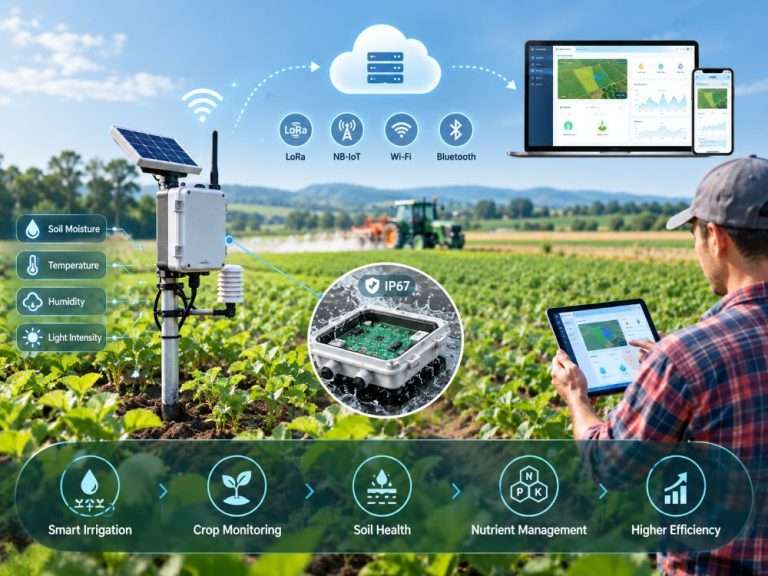
The Internet of Things (IoT) enables agriculture to convert data gathered from a network of sensors into insights that farmers can use to enhance their decision-making process regarding agricultural practices in a timely fashion.
Real-time data collection and cloud integration for data-driven farming decisions

Real-Time Field Monitoring

With IoT technology, farmers and cultivators are now able to effectively monitor field conditions on a continuous basis, as IoT-connected devices collect data on soil moisture, temperature, humidity, and light intensity. The device platform collects this information and transforms it into a continuous stream of field-related data.

Farm-to-Cloud Data Transfer

In addition to collecting data, IoT devices are capable of transmitting it. Using technologies such as LoRa, NB-IoT, Wi-Fi, and Bluetooth, the data will be transmitted after it has been collected. The required information is then sent to cloud computing systems where it can be stored and accessed remotely.

IP67 Enclosures and Reliable PCBAs

Outdoor electronic devices often need protection from the elements. The IP67-rated enclosure and the right choice of PCB material, coatings, connectors and sealing technologies can ensure the environmental protection of the PCBアセンブリ.

Cloud Dashboards and Remote Monitoring

The utilisation of cloud technologies allows for the storage and access of sensor data from several different locations. This means that farmers or livestock owners can see current and historical information through dashboards and manage their fields without having to be physically present everywhere they intend to monitor the conditions.

Data-Driven Irrigation, Crop, Soil, and Nutrient Decisions

Sensor data can be helpful for making insightful decisions about when and where to irrigate and whether the soil requires any attention, as well as whether the fertiliser has to be applied or not. This information allows for the use of resources according to the real field problems rather than just applying everything uniformly.

Precision farming data affects the efficiency of agriculture

Using data for precision farming can help combat needless usage of water, fertilisers, and electricity, enabling farmers to detect changes in soil conditions faster. By means of constant monitoring and automated communications and analysis, precision farming can improve the efficiency of resources and overall farm management.

Choosing the Right Agricultural IoT PCBA Partner

Precision agriculture systems depend on PCBAs that work reliably in harsh outdoor environments. Choosing the right PCBA supplier can determine whether your smart farming device survives one season or performs for years.
Look for a partner with:
A reliable partner should not just assemble boards. They should help you optimize power, improve durability, reduce maintenance, and bring your agricultural IoT product to market faster.
🌍 グローバルPCBA・フルターンキー

グローバル展開を加速する
信頼性の高いPCBAを使用

One-stop solution: PCB fabrication, sourcing, SMT assembly, testing & global logistics.
迅速な対応、厳格な品質管理。.

⚡ クイックターン 5-7日 🏭 ISO13485 / IATF16949 ✈️ 世界中へ配送
お問い合わせ →
⏱️ 24時間365日対応の専門家による相談

結論

Precision agriculture brings innovation in the agricultural field by combining sensors, wireless technologies, platforms, cloud computing, and other advanced electronics. Connectivity provided by PCBA with IoT allows sensors to transmit signals, manage data transmission, and ensure effective use of power. Due to evolving modern technologies such as LoRa, NB-IOT, Wi-Fi and solar energy forces it becomes possible to control even the most distant areas of vast areas but at the same time, waterproof equipment will help ensure that equipment survives various weather conditions.

FAQs About Agriculture IoT PCBA

The IoT moisture sensor is constantly measuring moisture levels in the dirt around the roots of the plantation and transferring updates to the system. Once the moisture level dips below a certain limit, the device is capable of notifying the farmer or even automatically turning on irrigation.
Yes, when moisture sensors help evaluate moisture levels in various parts of an agricultural area to determine whether any part of the farm has been watered enough. Having this information, farmers are able to water the crops optimally, cutting down on water consumption, eliminating unnecessary watering, and preventing waterlogging.
By using soil sensors installed in the field, farmers are constantly able to obtain readings on moisture, temperature, humidity, and other parameters of interest. This data will be transferred through wireless networks to cloud applications, enabling farmers to access the information remotely from a computer in order to take the necessary measures without having to go to the field every day.
By deploying LoRa technology, farmers will be able to communicate over relatively long distances without using much energy. Unlike other communication systems, which need to have communication infrastructure installed in the vicinity. LoRa is capable of collecting data from several sensors installed over large areas, making it relevant for remote agricultural monitoring.
Precision agriculture is based on the use of sensors, which allow farmers to define the exact moment when their plants need to be watered or given fertilisers. Instead of using the same amount of resources on every area of a field, farmers are able to avoid unnecessary watering, reduce water consumption, prevent waterlogging, and maintain more suitable soil conditions.
Having real-time data means that farmers have access to a lot of information about the changing conditions of soil and environment. By monitoring soil moisture, temperature, humidity, light and nutrient-related data, farmers will be able to detect any problem earlier and to make necessary decisions in time when it comes to the irrigation, feeding and growing of the crops instead of using manual observations.

FSテクノロジーと提携して、プロフェッショナルなPCBAサービスを手に入れましょう。

関連ブログ