
How Self-Driving Cars Work: The Role of PCB Technology

مقدمه
Please get in touch with us as soon as possible if you have any inquiries regarding تولید PCB and PCBA-related services for the automotive industry. We always place a high value on THE STANDARDS OF AUTOMOTIVE PCB. We also meet all of the following standards for automotive PCBs:
تولید و مونتاژ PCB خودرو
- IPC-6012DA
- AEC-Q100/AEC-Q200
- ایزو ۲۶۲۶۲
- JESD22-A100
- IEC 61508
- استاندارد UL 94
- استاندارد RoHS
- IPC-A-600G
- IPC/JEDEC J-STD-020
- IPC-A-610
Understanding Self-Driving Cars
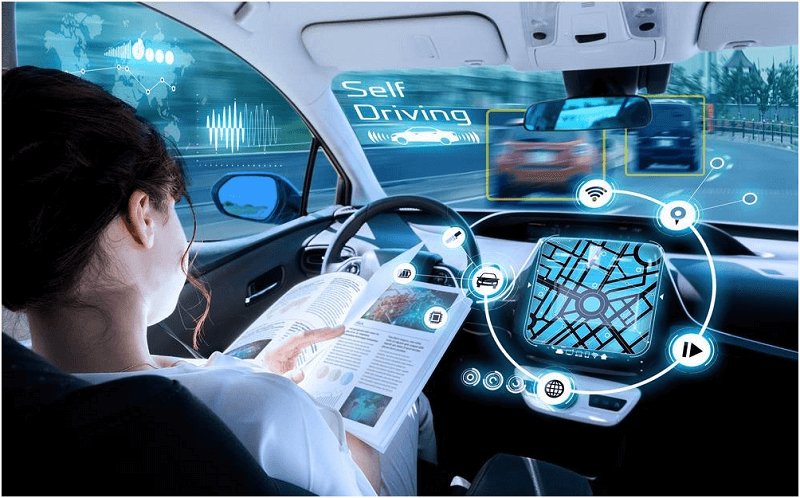
Self-driving vehicles work by obtaining data from the environment around them, relative to the engines’ onboard systems that control movement, and deciding in real-time what action to execute.
The Society of Automotive Engineers has categorized vehicle autonomy into 6 levels ranging from level 0 meaning no autonomy at all to level 5 which means ultimate or full automation. This classification assists in outlining the technological milestones of autonomous driving development.
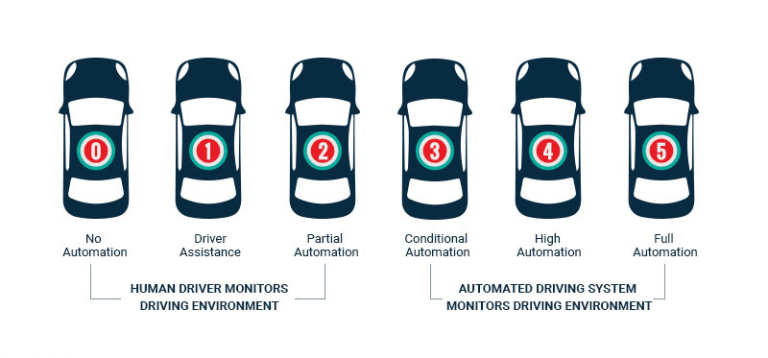
Components of Self-driving Cars
Sensors and Cameras
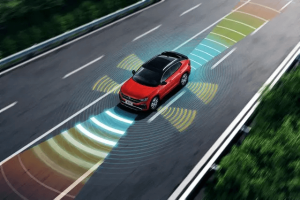
A variety of sensors and cameras are needed to observe the surrounding environment in self-driving vehicles. These devices may capture data about the environment in terms of the position of other cars, the presence of people, traffic lights, and roads.
These devices collect data relating to the environment in the form of the position of other cars and the number of people, the presence of traffic lights, and simply the roads in context. Key types of sensors include:
- Cameras: High-resolution cameras are used at several angles to ensure visibility of obstacles, reading of road signs, and recognition of lanes.
- Ultrasonic Sensors: These are short-range sensors that are used for parking and to recognize other nearby objects.
- Radar and LIDAR(in non-Tesla vehicles): Radar has the ability to gauge distance and estimate speed by emitting radio waves while LIDAR employs laser radiation to create a terrain map. On the other hand, Tesla has developed more advanced methods that do not utilize either technology, with their systems relying purely on vision.
Artificial Intelligence and Machine Learning
AI is the backbone of all moving automated vehicle technologies. Self-driving automobiles have artificial intelligence systems embedded in them that process the input from the sensors and cameras to see the ‘world’ around them. The AI system must:
- Detect and monitor objects in the vicinity, particularly motorized clients and pedestrians.
- Anticipate how drivers and pedestrians in the same area will behave to stay out of the way.
- Scenarios that require muscle memory and quick reactions such as pressing either the gas or brake pedal.
Central Control Units
In today’s self-driving cars, the most important component is the central control unit, which coordinates moving, accelerating, and braking after combining information from different sensors and هوش مصنوعی سیستمها.
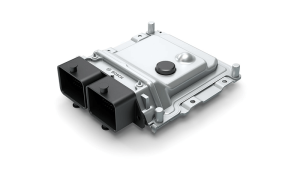
This unit connects and integrates everything thanks to Printed Circuit Boards, which module the high-speed transfer of data across systems.
The central control unit must be responsible for safety-critical systems where it should still be possible to control the vehicle safely in the event of AI failure. These kinds of systems are largely time-dependent, hence the need for advanced computing hardware and incredibly reliable PCBs in autonomous vehicles.
Understanding Self-Driving Cars PCB
We already know what AVs are. Let’s delve into driverless PCB.

Strategies for Self-driving Cars PCB Assembly
Component Placement and Orientation
Power Thermal Management
Component Sequencing
DRC Principle
The Role of PCBs in Autonomous Vehicles
Computers, automation technology, and autonomous vehicles all utilize a crucial component known as printed circuit boards. It serves the purpose of connecting different electronic systems and facilitating numerous communication linkages. The principal role of PCBs in self-driving cars is the management of multiple sensor data and the execution of decisions within milliseconds to guarantee safety and effectiveness.
Here is how PCBs power autonomous vehicles:
Reliability and durability
ادغام
Hardware interface requirements
Lidar Cooling And Thermal Management
Vehicle Control Architecture
انتقال داده با سرعت بالا
PCBs also serve the purpose of receiving and sending information at required speeds. Sensors allow for the collection of information that is disseminated to various parts of the vehicle. In steep and narrow circumstances, the vehicle will require cameras and control units that function effectively for a reliable and sufficient response.
Differences Between Self-driving Car PCBs And Automotive PCBs
The table below shows the main differences:
| ویژگی | Autonomous Vehicle PCB | Conventional Vehicle PCB |
| پیچیدگی | Highly complex, integrates multiple sensors and actuators, supports advanced driver-assistance systems (ADAS) | Relatively lower complexity, mainly supports basic electronic systems of the vehicle |
| سرعت انتقال داده | Requires high-speed data transfer to handle large amounts of sensor data | Lower requirements for data transfer speed |
| Layer Count and Density | Multi-layer boards, HDI boards, high-density wiring | Fewer layers, lower density |
| Materials and Environmental Resistance | Must withstand more extreme temperatures, humidity, vibration, and chemical corrosion | Lower requirements for environmental resistance |
| قابلیت اطمینان و دوام | Higher requirements, as autonomous driving functions are critical for safety | Lower requirements for reliability and durability |
| Electromagnetic Compatibility | Higher requirements due to the increase in sensors and communication devices | Lower requirements for electromagnetic compatibility |
| Sensor Integration | Integrates a greater variety and number of sensors, such as cameras, radar, LiDAR | Fewer sensor integrations |
| Smart Cockpit Features | Supports more complex smart cockpit features, such as multimedia, internet connectivity | Fewer or no smart cockpit features |
| Connected Vehicle Modules | Requires support for connected vehicle modules for high-speed communication and data transfer | May not support or have basic connected vehicle functions |
| ارزش | Higher value, especially for domain controller PCBs | Lower value |
| Growth Potential | Strong growth potential for HDI boards, with a CAGR of 16.5% expected | Lower growth potential |
The Future of Self-Driving Vehicles
Commercial Applications
The ride-hailing sector is bound to change with the introduction of Tesla’s Robotaxi which integrates numerous advances in mobility, making it virtually driverless. With an estimated price of around $0.20 per mile, Tesla’s advanced cab system is likely to change city transport for the better, making it high-quality and easier
Technological Challenges
Despite the progress made, full autonomy is still a long way off. Regardless of the constant improvements, Tesla’s Full Self-Driving system has not reached unregulated driving just yet. Rivals such as Waymo and Cruise are well ahead currently in the deployment of autonomous vehicles remotely controlled via geo-fencing technology.
Much emphasis on AI, sensor, and hardware development has relevance to Tesla’s goal of total safety that is fully autonomous. In this same regard, برد مدار چاپی manufacturing will be key to supporting such general advances through faster data processing and more secure vehicle system communications.
نتیجهگیری
PCB technology innovation and integration are essential to the development of self-driving automobiles. PCB makers play an essential role in the automobile industry as self-driving cars becoming smarter and more ecologically friendly. PCBs are being utilized more and more in modern cars for everything from entertainment systems to safety systems. In addition to providing electrical connections and mechanical support, they also meet our expectations for comfort, safety, and communication. We anticipate that self-driving cars will transform how we travel in the future as technology develops.
For automotive PCB assembly, you can select FS Tech as your partner. FS has been offering industrial PCB solutions for over a decade. For your PCB projects, we have the most comprehensive equipment and a committed staff. Are you interested in learning more about the production and assembly of PCBs? Contact us or send us an email to get started right away!
ما دوست داریم از شما بشنویم
وبلاگهای مرتبط
Table of Contents Design Rule Checking in PCB Design: From Altium DRC to SMT Assembly Published on September 10, 2024 · Updated on October 22,
Table of Contents Automotive PCB Assembly: The Complete 2026 OEM Guide Failure of a consumer good is a warranty claim. Failure of an automotive printed
Table of Contents Medical PCB Assembly: The Complete Guide for Medical Device OEMs Medical PCB Assembly is not a commodity process. It is a very
Table of Contents Drone PCB Design and Manufacturing: A Complete Guide for UAV Engineers This article was originally published in March 2024 and last updated
Table of Contents Security Camera PCBA Design Guide: Day/Night Switching and Infrared LED Driver Why Security Camera PCBA Design Matters for Day/Night Operation A security
Table of Contents AgTech Case Study: Manufacturing 2,000+ Agricultural Sensor Devices from Prototype to Production Designing an electronic prototype to large-scale production requires more than