فهرست مطالب

What Is SMT? Surface Mount Technology Explained for PCBA

This article was originally published in June 2022 and last updated on August 16, 2026.

Modern society uses electronics such as smartphones, laptops, vehicles, health care equipment, and industrial machinery, and almost all of these products use the same assembly process in manufacturing: فناوری نصب سطحی (SMT). Ever since you’ve pondered how so many small components can be assembled into a single circuit board and why modern-day products are so tiny, fast, and cheap, the answer to all of these questions is the revolutionary assembly process.
 
This article will help you understand what SMT is, how the whole SMT assembly process is performed, how it differs from through-hole assembly, and why selecting an appropriate SMT assembly service provider is crucial for your PCB assembly projects.
What is SMT: Surface Mount Technology

What Does SMT Mean in Electronics?

SMT stands for Surface Mount Technology. It is a method of manufacturing an electronic circuit in which the قطعات الکترونیکی such as resistors, capacitors, and مدارهای مجتمع are mounted on the surface of the برد مدار چاپی (برد مدار چاپی). In contrast to the traditional فرآیند تولید, SMT does not involve drilling holes through the PCB for the leads of components. Components are soldered by being placed on the solder paste that is printed on the PCB surface pads, and then the whole thing is heated in a reflow oven.
 
The SMT concept emerged in the 1960s when IBM presented the concept of “planar mounting” in a small-sized computer. This technique became popular during the 1980s – surface mount components accounted for 10% of the market share in 1986, whereas in 1990, most of the assemblies were done using SMT for its speed, density, and cost advantage. At present, more than 90% of the circuit boards are manufactured using SMT technology.

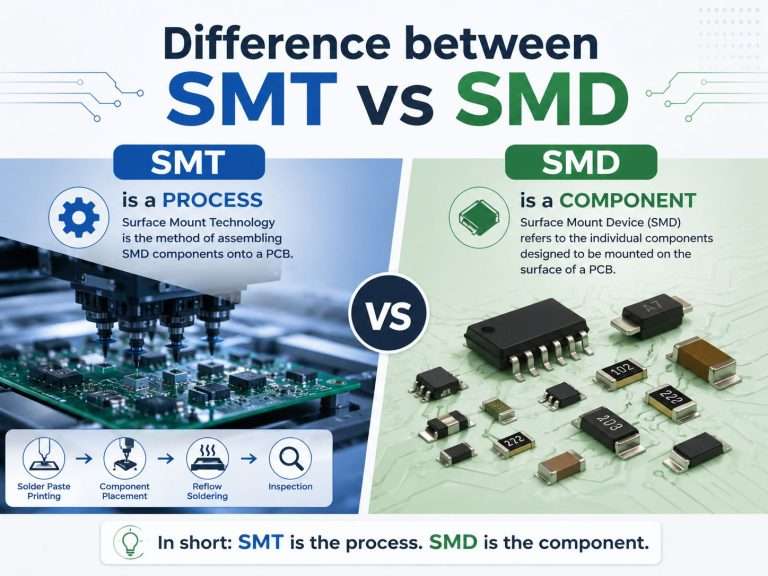
SMT در مقابل SMD: تفاوت بین SMT و SMD

People frequently use اس ام تی و اس ام دی interchangeably, but they refer to completely different things. Understanding the distinction is important when you specify requirements to a سازنده PCBA or write a لیست مواد اولیه (BOM). Here is a side‑by‑side comparison:
جنبهفناوری نصب سطحی (SMT)SMD (قطعه نصب سطحی)
What it refers toThe process of placing and soldering componentsThe physical components themselves (resistors, capacitors, ICs, etc.)
طبیعتA manufacturing methodologyElectronic parts with specific dimensions and terminations
مثال‌هاSolder printing, pick‑and‑place, reflow soldering0402 resistors, QFP packages, BGA chips, MLCC capacitors
Role in productionThe set of equipment and steps used to build the boardThe materials that are mounted onto the PCB
Common confusionOften misused as a synonym for “surface‑mount parts”Often misused as a synonym for “the assembly technology”
In short, SMT is what you do; اس ام دی is what you use. A board assembled using SMT contains many SMDs, but the two terms are not interchangeable.
SMT در مقابل SMD: تفاوت بین SMT و SMD
Click the Picture to Read More about SMT vs SMD

SMT Assembly Process: Step by Step

مدرن SMT assembly line is a wonder of speed automation technology that can place hundreds of thousands of components per hour with amazing accuracy. This process takes place in various stages.
 

چاپ خمیر لحیم

چاپ خمیر لحیم starts off the process. This entails positioning a metal شابلون PCB in such a way that it lies on top of the board, followed by running a squeegee tool over it to apply an exact amount of solder paste onto the particular pads on the surface of the board. Solder paste is a paste of solder particles and شار that serves as a kind of temporary glue to keep the components fixed and eventually create an electrical and mechanical connection.
 

بازرسی خمیر لحیم (SPI)

After the printing process, the printed circuit board is inspected for the solder paste that has been applied. The 3D بازرسی SPI uses optical techniques to check the location, shape, and thickness of the solder paste applied. This early inspection catches deviations before components are placed, preventing costly rework downstream.
 

Pick and Place

After the paste has been confirmed, the printed circuit board enters the pick-and-place process. This process uses high-speed robotic heads, which have optical alignment cameras and vacuum nozzles that will pick up the surface-mount devices from the component reels and then place them on the solder-pasted pads. Today’s equipment allows for an assembly speed greater than 100,000 parts per hour with an accuracy of approximately ±0.05 mm. The vision systems read reference marks on the circuit board to automatically correct the board’s position, ensuring components are placed exactly where they belong.
 

لحیم کاری مجدد

When all parts are positioned, the assembly is conveyed on a belt through an oven containing multiple zones: preheat, soak, reflow, and cooling. The oven gradually heats up using a profile-controlled process to form metallurgical joints between the leads of the اجزا و پدها on the PCB by melting the solder paste. Peak temperatures for lead-free solder materials such as SAC305 are 240 to 250°C. One of the subtle strengths of SMT appears in the process: The surface tension of the molten solder ensures that the misplaced components get aligned with the pads due to self-alignment.
 

بازرسی خودکار

This fully assembled board is inspected using inspection equipment. The SMT AOI process involves the use of high-resolution cameras and multiple light sources to detect any issues relating to component misalignment, absence of components, tombstoning (components that are standing on one leg), and solder bridging. In situations where there are hidden joints such as in BGAs, 3D x-rays are used to inspect the integrity of the joints. Some manufacturers also perform in‑circuit testing و آزمایش عملکردی to ensure the assembled board performs as designed.
 
Through this entire فرآیند SMT, quality control is observed throughout each step, starting from the incoming material check to functional testing. Well-regarded شرکت‌های PCBA adhere to certain industry guidelines such as IPC-A-610, where the workmanship acceptance levels are classified from Class II (general industries) to Class III (specialized industries like هوافضا and medical device industries).
خط مونتاژ SMT

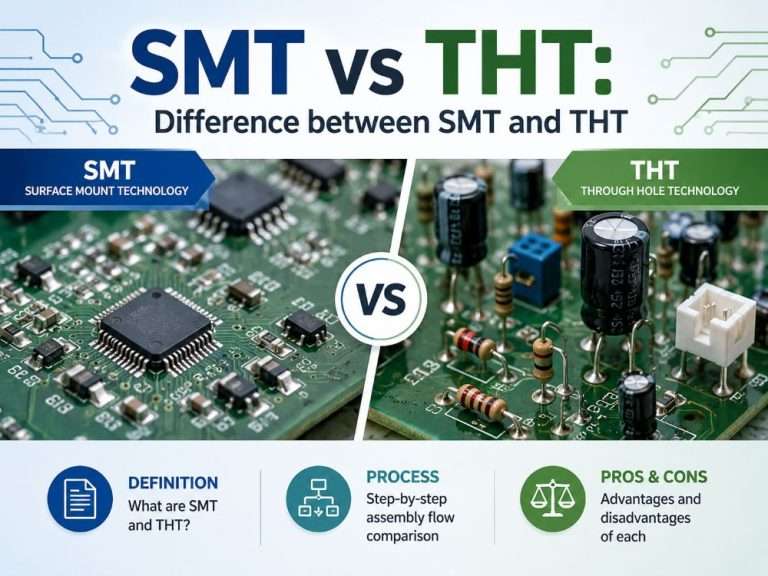
SMT vs THT: Difference between SMT and THT

Prior to the rise of SMT, the electronics industry was solely dependent upon فناوری سوراخ‌کاری (THT). In THT, component leads are run completely through the drilled holes on the PCB and are then soldered from the other side. Although both technologies are being used, their purposes are quite different from each other. The following table illustrates the differences between SMT و THT:
ویژگیاس ام تیتی اچ تی
Component size50–80% smaller and lighter than THT equivalentsLarger, with longer leads that go through holes
PCB drilling requiredNo — components sit on surface padsYes — holes must be drilled for every lead
Assembly automationFully automated (high‑speed pick‑and‑place)Typically manual or semi‑automated (wave soldering)
Assembly densityVery high — components can be placed on both sidesLower — usually single‑sided due to through‑hole leads
Mechanical strengthLower joint strength — susceptible to stressMuch stronger joints — excellent for heavy components
High‑frequency performanceExcellent — short leads reduce parasitic effectsPoorer — longer leads introduce inductance/capacitance
Rework and repairDifficult for fine‑pitch parts; requires specialised toolsEasier — can be soldered/desoldered by hand
Typical applicationsSmartphones, laptops, wearables, high‑speed digitalConnectors, power modules, transformers, rugged devices
Cost at volumeLower per‑unit cost due to automationHigher due to manual handling and drilling
SMT vs THT-Difference between SMT and THT
Click the Picture to Read More about SMT vs THT

How to Choose Between SMT and THT

Selecting the right assembly technology is not always a binary decision — many boards successfully combine both. In general, for boards that require dense packing, miniaturization, high-speed signals, and economic mass-production, choose SMT. This process is ideal for لوازم الکترونیکی مصرفی, portable equipment, and digital circuit boards.
 
Choose THT when the circuit board contains large connectors, power semiconductors, transformers, or anything else that will be subjected to repeated mechanical stresses and vibrations. It is only through-hole joints that possess mechanical strength that surface-mount joints cannot have. Moreover, THT is better in the case of prototype assembly and hand assembly due to its easy repairability.
 
In practical cases, the best choice of technology would be a فناوری ترکیبی approach, such that SMT would be used in case of dense logic and passive devices, whereas THT should be used for those few components which are heavy or require high reliability. Whenever working with a PCBA manufacturer, one should keep in mind to mention the mechanical as well as environmental considerations of his application during the initial stages of design.

Why SMT Matters: The Key Benefits

Understanding what SMT is is only half the story. The real value lies in what SMT enables.
 
  • Miniaturisation is one of the obvious advantages of SMT. SMD can be as small as one-tenth of the mass of through-hole parts. Such miniaturisation has enabled the development of smartphones, wearable electronics, and other small gadgets that have become an indispensable part of modern life.
  • Performance enhancement is the other major advantage of SMT. Since shorter electrical pathways result from SMT, there will be fewer parasitics, thus enabling circuits to function at much higher speeds with less signal integrity loss.
  • Cost effectiveness arises due to automation. After the SMT line is set up, assembling becomes an automated process, resulting in significant cost savings per unit, as compared to مونتاژ از طریق سوراخ – typically ranging between 30 to 50 per cent per unit. Automation also helps reduce human error risk and ensures consistent quality across production runs.
  • چگالی بالا is yet another important feature. Using SMT technology, components can be mounted on both sides of the board with greater proximity than could ever be possible using through-hole assembly techniques. This translates into higher packing density, which makes high functionality available in small spaces – an essential factor in all electronic categories.

Applications of SMT in Electronics

Surface Mount Technology is ubiquitous. It is the basic assembly method for consumer electronics products such as smartphones, tablets, laptops, and other wearable devices. Automotive electronics including engine control units (ECUs) and driver assistance systems, also make use of مونتاژ SMT. Medical devices depend on SMT technology for compact and highly reliable assemblies used in diagnostic instruments, monitors, and implantable devices. Industrial controls, communication systems, aerospace technology, and LED lighting all require SMT for their PCB assemblies.
 
The global Surface Mount Technology market is evidence of this phenomenon. With an estimated value of about USD 6.6 billion in 2025, the market is expected to expand to more than USD 10 billion by 2031 on account of the rising trends of automation, smaller electronic components and high-precision لحیم کاری جریان مجدد. Trends in the industry indicate that the future belongs to Industry 4.0-powered smart SMT systems, which integrate هوش مصنوعی, robotics, big data, and اینترنت اشیا-enabled monitoring into assembly lines.

Quality Standards in SMT Assembly

Quality must always be a prime consideration when sourcing خدمات PCBA. Most reliable PCB companies that offer خدمات مونتاژ SMT operate according to the standards set by the industry.
 
IPC-A-610 is the most recognized one, and it is referred to as the “Acceptability of Electronic Assemblies.” It sets the criteria for acceptability of solder joints. Class II specification relates to general industrial products where extra reliability is not required. Class III relates to high-reliability products where continuous functioning is required — such as aerospace, military, and medical life‑support systems.
 
Other than IPC guidelines, a quality-conscious surface-mount technology assembly process involves several phases of inspection, which include SPI after paste application, AOI before and after the reflow stage, بازرسی با اشعه ایکس برای Ball Grid Arrays (BGAs) and any other obscured connections, and functional testing of the assembled products. Other certifications that prove a company’s dedication to quality include ISO 9001 (quality management), IATF 16949 (automotive industry), ، و ISO 13485 (medical devices).
 
A reliable PCBA manufacturer will also offer طراحی برای قابلیت ساخت (DFM) review before production begins, identifying potential issues in the design that could affect assembly yield or reliability. This proactive approach prevents problems before they occur and ensures a smoother path from prototype to production.

نتیجه‌گیری

Surface Mount Technology is what drives modern electronics assembly processes. Since its inception in the 1960s and now through its leading role today, SMT technology has been responsible for the miniaturization, performance, and cost savings that have helped us to build the products we depend on each day. No matter whether you are building a consumer product, an automotive system, or even a medical device, knowing SMT meaning and the SMT assembly process is key to making smart decisions on your PCBA project.
 
Selecting the right partner for your PCB assembly is important. This can be achieved by selecting a partner that has experience, certification, inspection capability, and willingness to do design for manufacturability. The right partner will not only assemble your boards — they will help you design for success.
Are you planning your next PCBA project and need reliable خدمات مونتاژ SMT? Contact us to discuss your requirements, request a quote, or schedule a free DFM review of your design. Let’s build something great together.

FAQs about SMT

SMT (Surface Mount Technology) is the assembly process — the method of placing and soldering components onto a PCB. SMD (Surface Mount Device) refers to the actual components themselves, such as resistors, capacitors, and ICs, that are designed to be mounted using SMT. In short, SMT is the فناوری; SMD is the parts.
You should choose through-hole technology when your board includes large connectors, power semiconductors, transformers, or components that experience repeated mechanical stress, vibration, or high insertion forces. THT provides mechanically stronger solder joints that are much more robust than surface-mount connections. It is also easier to hand-solder and rework during prototyping.
During reflow soldering, the assembled board passes through a multi-zone oven that heats it in a carefully controlled thermal profile: preheat, soak, reflow, and cooling. The solder paste melts at peak temperatures of about 240–250°C (for lead-free alloys like SAC305), forming metallurgical bonds between the component leads and the PCB pads. One unique benefit of this process is the self-centering effect — the surface tension of molten solder pulls slightly misaligned components into correct position, improving yield.
Look for proven experience with similar board types, industry certifications (ISO 9001, IPC-A-610, and relevant sector-specific standards), robust inspection capabilities (SPI, AOI, X-ray, and functional testing), and a willingness to offer a Design for Manufacturability (DFM) review before production. A good partner will not only assemble your boards but also help optimise your design for higher yield, lower cost, and faster turnaround.

وبلاگ‌های مرتبط

با FS Technology همکاری کنید، از خدمات حرفه‌ای PCBA بهره‌مند شوید