
Table of Contents
Taconic PCB Materials: The Gold Standard for High-Frequency & RF Circuits
What is Taconic Advanced Dielectric PCB Material?
Taconic Key PCB Materials Product Lines
| Material Series | Description | Applications |
|---|---|---|
| TLY Series | Ultra-low Dk (2.17) and low loss, PTFE-based. Ideal for high-frequency circuits. | Antennas, power amplifiers, RF/microwave circuits requiring high signal integrity. |
| RF-35 Series | Balanced performance and cost, low Dk with moderate loss. | RF and microwave circuits, telecommunications, base station antennas, RF filters. |
| CER-10 | Ceramic-filled PTFE laminate with high Dk and low loss. | Compact high-frequency designs, power amplifiers, microwave filters. |
| TLX Series | Stable Dk and low loss, suitable for broadband applications. | Phased array antennas, satellite communications, broadband microwave devices. |
| Taconic 600 Series | Low moisture absorption, low loss, and good thermal stability, designed for harsh environments. | Aerospace, military electronics, automotive radar systems. |
Why are Taconic PCB Materials Beneficial for HF Circuits?
- Outstanding Electrical Performance: Due to the low dissipation factor (Df), Taconic’s laminates are capable of minimizing signal attenuation even at millimeter waves. The low and stable Dk of the material also assures good performance over a wide range of frequencies and temperatures.
- Superior Thermal Management: The printing boards are capable of functioning well within a wide range of temperatures. The low Coefficient of Thermal Expansion (CTE) of the PCB materials prevents the boards from curling and delaminating.
- Established Reliability: The high resistance to moisture and chemicals of Taconic PCBs makes them the best choice for the aerospace, military, and automotive industries that require absolute durability.
- Precision Fabrication: The dimensional stability of the laminates is outstanding and plays a key role in aligning the multi-layer boards exactly within RF systems.
Taconic PCB Materials Manufacturing Process
- Material Selection: PTFE resin formulated with specific filler materials provides low dielectric loss.
- Reinforcement: Glass and/or ceramic materials are used to improve the resistance to deformation
- Prepreg Preparation: The PTFE resin is impregnated into fabric reinforcement and then B-staged.
- Lamination: Layers are pressed together using a copper foil using high heat and pressure.
- Cooling & Surface Treatment: Cooling is controlled to avoid warping, and the surfaces of the copper wires are treated to ensure good adhesion.
- Quality Control: Each sheet undergoes electrical and dimensional testing.
- Cutting & Packaging: The laminates are accurately cut, inspected, and packed before being shipped.
When to Use Taconic PCB Materials?
When Taconic Materials Are Essential:
- High Frequency Operation: RF, microwave, and millimeter waves that work above 10 GHz require low losses in your design.
- Mission-Critical Reliability is Required: The system must operate correctly in harsh environments (temperature, humidity, vibration), which are typical of aerospace, military, and space-related applications.
- Signal Integrity is of Utmost Importance: The slightest phase amplitude distortion is not acceptable in modern radar technologies and communication systems.
When Other Materials Might Be More Practical:
- Since the operating frequency is lower, FR-4 could be sufficient for the required circuit.
- The project is very sensitive to costs, but Taconic’s competitive advantage is not valid in the current scenario whatsoever.
- The operating conditions are conducive, and there are no requirements of resistance to high temperatures, chemicals, and wear.
Taconic PCB Material Types and Applications

Fabric
High heat-resistant materials, produced through the coating of glass and aramid fibers with PTFE resin.
Applications: Used where durability and releasing properties are required.
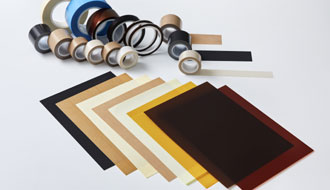
Tape
Adhesive tapes featuring PTFE and PI films and a layer of silicone and acrylic adhesive.
Applications: Used for insulation, sealing, and protection.

Belt
PTFE belts designed to withstand high temperatures.
Applications: Used for drying, hardening, and transferring material in industrial applications.

PTFE/FEP Composite Film
Composite films combining PI with fluororesins like PTFE and FEP.
Applications: High performance applications that require resistance to chemicals and flexibility.

Reusable Silicone Tape
Double-sided, reusable silicon tapes with various adhesive strengths for each side.
Applications: Characterized by operation at high temperatures, reusability, and high adhesive strength.

UHMW PE Film Tape
Ultra-high molecular weight polyethylene tape prized for its excellent resistance to abrasion.
Applications: Used for applications requiring high durability and wear resistance.

Architecture Fabric
PTFE materials used for the construction of membrane structures.
Applications: Ideal for architectural applications requiring weather resistance and structural integrity.
Taconic vs. Rogers: Strengths and Weaknesses
Taconic:
Strengths:
- Dielectric Constant (Dk): The dielectric constants of Taconic PCB materials, such as TLY material, are typically measured between the values of 2.17 and 2.33, which renders the material very useful for high-frequency applications where the least distortion of the signal is required.
- Low Dielectric Losses: For example, the TLY material has a low-loss tangent of 0.0019 at a frequency of 10 GHz. This becomes a critical aspect when considering RF and microwave applications.
- Thermal Stability: Taconic materials exhibit a high level of temperature stability of up to 260°C, which is able to withstand rugged conditions and is a requirement for aerospace applications.
- Moisture Resistance: The moisture absorption of Taconic PCB materials is low, and thus their resistance to moisture is good and is also a contributing factor to Taconic PCB reliability.
Weaknesses:
- Cost: Taconic materials are relatively more expensive because of the special characteristics that they possess.
- Processing: These materials may also be more difficult to process than other materials, and special equipment might be required.
Rogers:
Strengths:
- Dielectric Constant (Dk): The Dielectric Constant of the Rogers materials, for example, for material RO4350B, is about 3.48, which is slightly higher than other materials but also within a range that accommodates a variety of RF/Microwave applications.
- Ease of Processing: The materials produced by Rogers are relatively easy to process, and this could result in lower production costs.
- Flexibility: One of the factors that makes Rogers a very popular material is its flexibility that works well in different PCB applications, such as telecommunication, automobile, and consumer products.
- Thermal Performance: The operating temperature range of up to 150°C is normal for the majority of the materials used by Rogers, but for high-frequency designs, a material such as RO4350B is sufficient for thermal performance.
Weaknesses:
- High Loss TAN Beta: This material type could have slightly elevated TAN Beta than Taconic PCB materials. For example, for the material RO4350B, tan del zips of almost 0.0037 at a frequency of 10 GHz, which is slightly elevated than the Taconic material.
- Temperature Sensitivity: The temperature sensitivity of the material supplied by Rogers could also be slightly higher than Taconic, but it is unlikely to be a concern.
| Model | Dielectric Constant Dk | Dielectric Loss DF |
|---|---|---|
| Rogers | ||
| RO3003 | 3.00 ± 0.04 | 0.0010 |
| RO3006 | 6.15 ± 0.05 | 0.0020 |
| RO3010 | 10.2 ± 0.30 | 0.0022 |
| RT5880 | 2.20 ± 0.02 | 0.0009 |
| RO4003C | 3.38 ± 0.05 | 0.0027 |
| RO4350B | 3.48 ± 0.05 | 0.0037 |
| RT5870 | 2.33 ± 0.02 | 0.0012 |
| RT6010 | 10.2 ± 0.25 | 0.0023 |
| Taconic | ||
| TLY-5A | 2.17 | 0.0009 |
| TLP-5 | 2.10 | 0.0009 |
| TLY-5 | 2.22 | 0.0009 |
| TLY-3 | 2.33 | 0.0012 |
| TLA-6 | 2.65 | 0.0020 |
| RF-35 | 3.50 | 0.0018 |
| TLT-0,9,8,7,6 | 2.45 - 2.65 | 0.0015 - 0.0021 |
Data Summary:
- Dielectric Constant (Dk): Taconic: 2.17 – 2.33 | Rogers (RO4350B): 3.48
- Loss Tangent: Taconic: 0.0019 @ 10 GHz | Rogers (RO4350B): 0.0037 @ 10 GHz
- Thermal Stability: Taconic: Up to 260°C | Rogers: Up to 150°C
Conclusion
FAQs about Taconic PCB
Taconic materials offer far lower dielectric loss and higher thermal stability, making them suitable for high-frequency and high-speed circuits where FR-4 fails to maintain signal integrity.
Yes. Taconic materials are designed for compatibility with standard lamination and etching processes, though minor process tuning may optimize performance.
For ultra-high-frequency or extreme-temperature applications, Taconic often outperforms Rogers. However, for general RF or cost-sensitive designs, Rogers may be a more practical choice.
It depends entirely on the application’s demands. For consumer electronics, likely not. For a satellite payload or a military radar system where failure is not an option, the investment in Taconic’s performance and reliability is not just justified—it’s essential.
Get a quote
Related Blogs
Table of Contents Medical PCBA Cost in 2026: What Really Drives the 2.5–4× Premium Over Commercial Boards Medical PCBA costs do not only depend on
Table of Contents PCBA Functional Testing (FCT): A Complete Guide to Ensuring Board Reliability Published on May 9, 2023 · Updated on November 6, 2026
Table of Contents IPC Class 2 vs Class 3: Acceptance Criteria, Cost Impact, and How to Choose IPC Class 2 and Class 3 are the
Table of Contents Ventilator PCB Assembly: ISO 13485, IPC Class 3 & FDA QMSR-Ready Manufacturing Published on June 24, 2022 · Updated on October 30,
Table of Contents Ventilator PCB Assembly: ISO 13485, IPC Class 3 & FDA QMSR-Ready Manufacturing How is air delivered steadily with the help of ventilators,
Table of Contents Design Rule Checking in PCB Design: From Altium DRC to SMT Assembly Published on September 10, 2024 · Updated on October 22,