
PLC Controller PCBAs: How to Ensure a Lifespan of 10+ Years in Harsh Industrial Environments
Challenges Affecting PLC PCBA Reliability
- Thermal Cycling: Repeated expansion and contraction of materials with differing coefficients of thermal expansion (CTE) induce fatigue in solder joints and interconnects. This cyclic stress accumulates over time and is a primary mechanism for latent failure.
- Mechanical Vibration: Rotating equipment, reciprocating pumps, and conveyor systems generate broadband mechanical vibration. Prolonged exposure can cause fretting corrosion in connectors, loosening of mechanical fasteners, and stress fractures in component terminations.
- Particulate Contamination: Airborne dust accumulates on PCBA surfaces and within enclosures. This contamination can create conductive paths, reduce insulation resistance, and absorb ambient moisture, accelerating electrochemical migration.
- Humidity and Condensation: Moisture ingress promotes corrosion of copper traces, oxidation of contact surfaces, and leakage currents. In severe cases, condensation leads to short circuits between adjacent conductors.
- Electromagnetic Interference (EMI): Variable frequency drives, welding equipment, and switching power supplies generate conducted and radiated emissions. These disturbances can interfere with analog signal conditioning, communication buses, and processor logic states.
Critical Design Strategies for Maximizing PLC PCBA Longevity
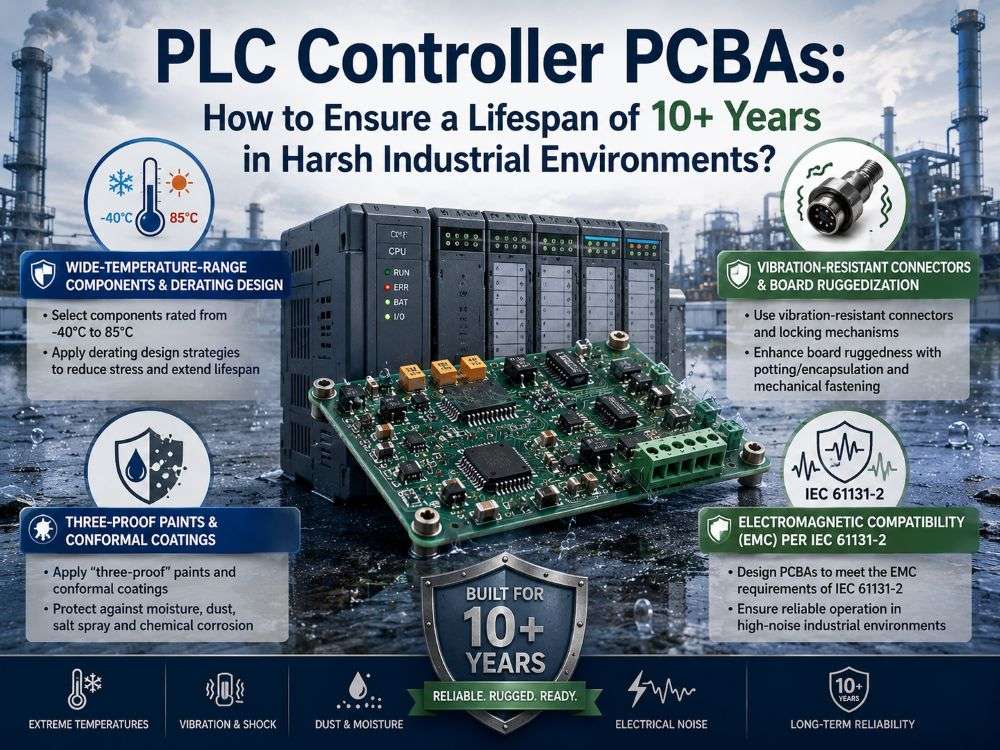
Use Wide-Temperature Parts and De-rate Design
Create Mechanical Robustness through Design Ruggedisation
Protect PCBAs From Dust and Humidity
Ensure PCB Assemblies Meet the IEC 61131-2 EMC Code
Significance of EMC Compliance in PLC PCBA
Sources of Electromagnetic Interference in Industrial Facilities
Risks to PLC Performance and Stability
Compliance with Industrial Standards
Improve PLC Reliability and Prevent Possible Safety Concerns
EMC Design Practices of PLC Controller PCBA
- Grounding and PCB Design: Having a continuous ground plane and designing the PCB with good routing will help to minimise the amount of electrical noise present. The proper routing of signals and the correct placement of traces will minimise current loops and signal interference for reliable communication and control.
- I/O Filtering: Common-mode chokes and ferrite beads are placed on every I/O line at the connector entry point. Differential-mode LC or RC filters are implemented for analog input channels.
- Shielding: Enclosures are constructed of conductive materials or coated with conductive paint. Shielded cables with 360° connector backshell termination are specified for communication lines.
- Surge and ESD Protection: TVS diodes, MOVs, and other protective components for ESD are used to protect the PLC PCBAs against voltage spikes and electrostatic discharge. Research has shown that preserving the integrity of signals is critical in industrial PCBAs. Routing the traces correctly will improve the integrity of signal transmission.
- Layer Stack-Up Optimization: Optimising the PCB layer stack-up design will provide an improved level of EMC through the dedicated power and ground planes available. Proper layer design will reduce radiated emissions and noise, which will enhance the overall performance of the circuit.
Summary of Design Requirements for 10+ Year Service Life
- Select suitable components rated between -40°C and +85°C operating temperature.
- Derate electrical (current) and thermal (heat) ratings of the used components.
- Utilise vibration-resistant connectors.
- Use ruggedised PCB design in critical areas.
- Add potting, encapsulation, and other mechanical attachment methods.
- Use 3-proofs and conformal coating for assembly protection.
- Minimise exposure to dust, moisture, and corrosion.
- Design PCBA’s to comply with IEC 61131-2 criteria for EMC.
- Look at existing causes of industrial EMC issues.
- Utilise proper grounding, shielding, filtering, surge protection, and ESD protection techniques.
- Test for reliability with industry-recognised testing methods.
- Integrate environmental protection and EMC processes for a total service life of over 10 years.
Conclusion
FAQs about PLC PCBA
Partner with FS Technology, Get Professional PCBA Service
Related Blogs
Table of Contents What is an Integrated Circuit (IC): Types, Working Principle & Manufacturing Process This article was originally published in Aug 2023 and last
Table of Contents SMD Components: Beginner-Friendly Guide to Surface Mount Devices This article was originally published in November 2022 and last updated on June 1,
Table of Contents SMT vs SMD: What is the Difference Between SMD and SMT? A complete guide to Surface Mount Technology and Surface Mount Device
Table of Contents Wire Soldering 101: How to Solder Wires to a Circuit Board Soldering wire is the fundamental skill in electronics where wire to
Table of Contents How to Enhance PCBA Durability and Longevity PCB and PCBAs are extensively utilized in many electronic devices and are essential to electronics
Table of Contents Design Rule Checking in PCB Design Workflow: A Step-by-Step Guide What is Design Rule Checking (DRC) Design Rule Checking (DRC) is a