
目次
SMT vs THT: Differences between SMT and THT in PCB Assembly
This article was originally published in May 2023 and last updated on June 16, 2026.
SMTとは?
Difference Between SMT and SMD?
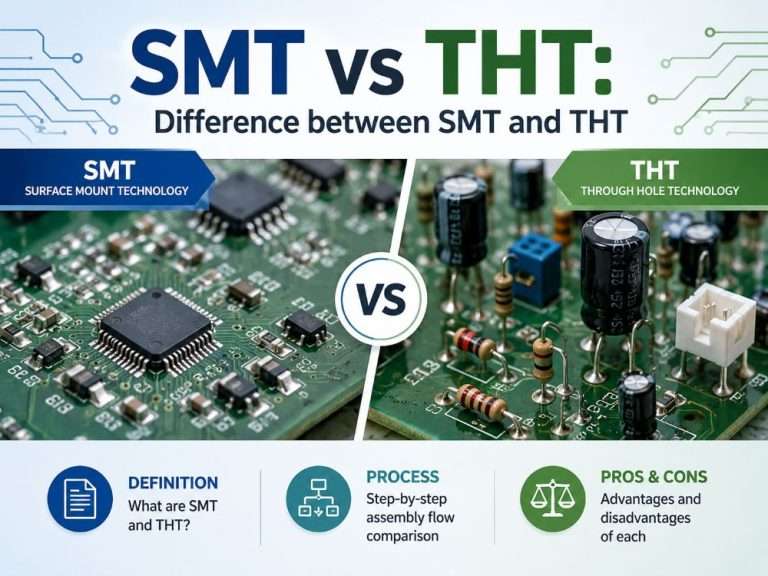
- SMT (Surface Mount Technology) refers to the アセンブリプロセス または 技術 used to solder components onto a board.
- SMD (Surface Mount Device) refers to the actual component itself — such as resistors, capacitors, ICs, or LEDs — that is designed to be mounted using SMT.
Typical SMT Assembly Process
ステップ1:ソルダーペースト印刷
Step 2: Pick & Place (Mounting Components)
ステップ3:リフローはんだ付け
Step 4: Automated Optical Inspection (AOI) & X-ray
- AOI, a test using high-quality cameras that detects any missing elements, misaligned components, bridging, or poor soldering.
What is THT?
Typical THT Assembly Process
Step 1: Component Lead Preparation / Forming
Step 2: Component Insertion
- Manual through operators (for prototypes, small runs)
- Machine-operated (automatically) insertion using machines capable of mass production, mainly for standard component types like connectors, switches, and transformers.
ステップ3:ウェーブはんだ付け
Step 4: Trimming Excess Leads
Step 5: Inspection
- 目視検査 is conducted to make sure there is no problem with missing parts, solder bridging, poor wetting or cold joints.
- In-circuit testing (ICT) または フライングプローブテスト can be applied to test the conductivity of the board, more specifically when dealing with mixed technology boards with important through-hole connectors or 電源 parts.
概要
Advantages and Disadvantages of SMT

Advantages and Disadvantages of THT
SMT vs THT: Key Differences Between SMT and THT
| 特徴 | SMT (Surface Mount Technology) | THT (Through-Hole Technology) |
| Component mounting | Components placed on PCB surface | Component leads inserted through drilled holes |
| Holes required | いいえ | Yes – holes drilled through the board |
| Component size | Much smaller and lighter | Larger and heavier |
| Component leads | Small pads or terminations | Long leads that pass through the board |
| Soldering method | Reflow soldering (oven) | Wave soldering or hand soldering |
| Assembly speed | Very fast (automated pick & place) | Slower (insertion, soldering, trimming) |
| Component density | Very high – components on both sides | Low – limited by hole spacing and lead access |
| Mechanical strength | Moderate – relies on solder joint | Excellent – leads anchored through the board |
| Thermal/mechanical stress resistance | Lower – can crack under flex or repeated heat cycles | Higher – suitable for connectors, transformers, heavy parts |
| Rework & repair | More difficult (requires hot air, special tools) | Easier – can be desoldered with basic tools |
| Prototype friendliness | Harder to hand-solder (small pitch) | Easy to hand-solder |
| Cost for high volume | Lower – faster, fewer steps | Higher – drilling, insertion, trimming add cost |
| Cost for low volume / prototype | Higher setup (stencil, pick & place programming) | Lower – can be done manually |
| Typical applications | Smartphones, laptops, tablets, high‑density consumer electronics | Power supplies, automotive modules, aerospace, large connectors |
When to Use SMT vs THT?
- If it has to endure constant pulling, shaking, or plugging → THT.
- If it has to be compact, lightweight, and inexpensive in large quantities → SMT.
- Otherwise, assume SMT and resort to THT when needed.

Why Choose FS Tech PCBA Services for SMT and THT?
- High-tech equipment – Pick-and-place machines, reflow soldering, wave soldering, AOI/X-Ray inspection.
- エクセレント 品質管理 - AOI testing for SMT PCB; ICT testing for THT PCB.
- Variable volumes – Prototype from 10 pieces to mass production above 50,000 pieces without MOQ.
- One-stop solution – Both SMT and THT manufacturing in our PCBA factory, saving time and logistics fees.
- Design support – FREE review and manufacturability suggestions.
- Rapid delivery - ラピッドプロトタイピング and reliable delivery time on large orders.
グローバル展開を加速する
信頼性の高いPCBAを使用
One-stop solution: PCB fabrication, sourcing, SMT assembly, testing & global logistics.
迅速な対応、厳格な品質管理。.
結論
FAQs about SMT vs THT
Partner with us & Start your PBCA Project
関連ブログ
Table of Contents PCBA Functional Testing (FCT): A Complete Guide to Ensuring Board Reliability Published on May 9, 2023 · Updated on November 6, 2026
Table of Contents Design Rule Checking in PCB Design: From Altium DRC to SMT Assembly Published on September 10, 2024 · Updated on October 22,
Table of Contents PCB Meaning: What Is a Printed Circuit Board? This article was originally published in July 2022 and last updated on Sept 10,
Table of Contents Custom PCB Design and Manufacturing: A Comprehensive Guide for Engineers and Product Developers This article was originally published in Mar 2024 and
Table of Contents How to Read a Circuit Board: A Complete Step-by-Step Guide for Engineers and Technicians (2026) Printed Circuit Board Assemblies (PCBAs) form the
Table of Contents What Is SMT? Surface Mount Technology Explained for PCBA This article was originally published in June 2022 and last updated on August