
目次
SMTとSMDの違いとは?表面実装技術と表面実装デバイスに関する完全ガイド
This article was originally published in June 2022 and last updated on May 15, 2026.
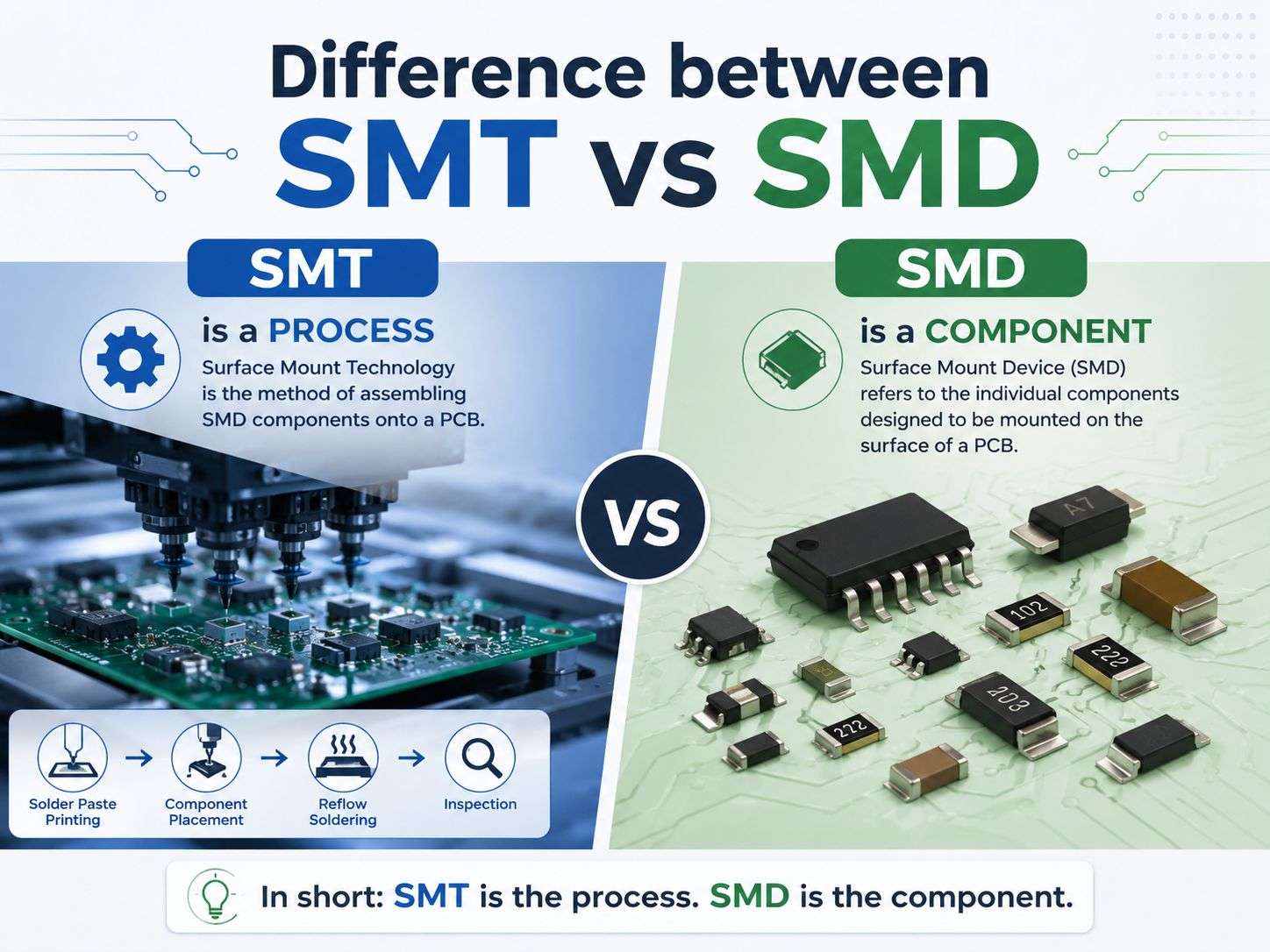
表面実装技術
SMTとは?
SMTアセンブリ工程
- はんだペースト印刷
- 検査とテスト
Characteristics of SMT
- High density – Components can be placed very close together, even on both sides of the PCB, making products smaller and lighter.
- High reliability – SMD components resist vibration and shock better, with lower solder joint defect rates.
- Good high-frequency performance – Short leads reduce electromagnetic and radio frequency interference.
- Suitable for automation – Machines can place thousands of components per hour, improving efficiency and lowering costs.
表面実装デバイス
SMDとは?
Common SMD Component Types
- SMD抵抗器 – For current limiting and voltage division. When mounted on ceramic PCBs, a glass passivation film may be applied to prevent solder overflow.
- SMD capacitor (ceramic) – For filtering and energy storage. Widely used in high-frequency circuits (e.g., engine control, communication equipment).
- SMD transistor (SOT package) – Such as SOT-23, SOT-89; pioneers of surface mount active devices.
- SMD integrated circuit (IC) – Packages like SOP, QFP, BGA integrate thousands or millions of transistors into a tiny chip. These SMD package types vary by pin count and size.
Characteristics of SMD
- Small, light, thin – Meets the demand for miniaturization of electronic products.
- Good high-frequency characteristics – Short leads reduce parasitic parameters.
- High reliability – Suitable for automated 大量生産.

Difference Between SMT vs SMD
| 寸法 | SMT (Surface Mount Technology) | SMD (Surface Mount Device) |
| Nature | A manufacturing process / technology | An electronic component / device |
| Focus | How to assemble? Which method? | What to assemble? Which part? |
| Commonly associated terms | Assembly, soldering, reflow soldering, pick-and-place machine | Component, part, package, resistor, capacitor |
| 目的 | To achieve automation, high precision, high efficiency | To achieve miniaturization, high-density integration, light weight |
| Interchangeable? | SMT process is designed for SMD; it cannot directly handle through-hole components | SMD components can be assembled not only by SMT but also by manual soldering, hot air, wave soldering, etc. |
How Do SMT and SMD Work Together?
| Combination point | 利点 |
| Small size of SMD + high-density placement of SMT | More functions on small PCBs (smartphones, smartwatches). |
| SMT automation + standard SMD packages | High speed (thousands of components per hour), low labor cost. |
| Lead‑free SMD + precise SMT soldering | Reduces soldering defects and improves long‑term reliability. |
| Double‑side SMT placement + thin and light SMD | Maximizes PCB utilization and minimizes product volume. |
When need to know the difference between SMT and SMD?
- Requesting a quote from a PCBA factory or placing an order
- PCB design and component package selection
- Evaluating a supplier’s production capability
- Optimizing production cost and lead time
- Reading technical documents or writing specifications
FS Technology PCB Assembly Services: one‑stop SMT + DIP PCBA
- SMT Assembly Service – For all types of SMT components (from 0201 miniature resistors to 0.4mm‑pitch BGA chips), we use fully automated SMT lines, high‑precision printers, 10‑zone reflow ovens, and 3D-AI-AOI inspection equipment to ensure every SMD is accurately and reliably placed on the PCB.
- ディップ Through‑hole Assembly Service – Not all components are suitable for SMT. Some high‑power devices, connectors, or special‑package components still use through‑hole form. Our DIP line provides manual insertion + wave soldering + touch‑up soldering, seamlessly integrated with the SMT section.
- One‑stop advantage – Customers do not need to find separate SMT and DIP factories. We manage all steps under one roof: BOM verification, stencil fabrication, 部品調達, SMT placement, DIP insertion, testing, and packaging. This ensures efficient placement of SMD components on the SMT line while also guaranteeing reliable soldering of through‑hole components.
Key Takeaways of SMT vs SMD
- Surface Mount Technology (SMT) is a manufacturing process. It solves “how to assemble.”
- Surface Mount Device (SMD) is a physical component. It answers “what to assemble.”
結論
FAQs about SMD vs SMT
SMD = 表面実装デバイス – the actual electronic component (e.g., resistor, capacitor, IC) that is mounted onto the PCB.
局留め = 表面実装技術 – the entire manufacturing process used to place and solder SMDs onto a PCB.
No. They are closely related but not interchangeable.
SMD refers to the コンポーネント itself.
局留め refers to the technology / process of assembling those components onto a board.
You can say: “This PCB uses 局留め to assemble many SMD.”
Yes, but it’s not “SMT” in the industrial sense.
You can hand-solder larger SMDs (e.g., 1206, SOIC) with a fine-tip iron and tweezers.
Smaller SMDs (e.g., 0402, 0201) or BGAs are nearly impossible to hand-solder reliably – they require SMT processes like reflow ovens.
Hand-soldering an SMD is still using an SMD component, but it is not full SMT assembly.
スルーホール (THT) came first (1950s–60s).
SMD/SMT was developed in the 1960s and became mainstream in the 1980s because it allows smaller, lighter, and higher-density PCBs.
That’s not an SMD vs SMT question – it’s SMT vs through-hole.
SMT advantages: smaller size, lower cost for high volume, better high-frequency performance, double-sided assembly.
Through-hole advantages: stronger mechanical bond (for connectors, heavy parts), easier hand-prototyping, better for high-reliability (vibration).
Most modern boards use SMT + SMDs for 90% of components, plus a few through-hole parts.
Not necessarily – see #3. But for production or tiny packages (0402 and smaller), you really need SMT equipment (stencil printer, pick‑and‑place, reflow oven) for reliable results.
関連ブログ
Table of Contents What Is SMT? Surface Mount Technology Explained for PCBA This article was originally published in June 2022 and last updated on August
Table of Contents SMT vs THT: Differences between SMT and THT in PCB Assembly This article was originally published in May 2023 and last updated
目次 PCBAの意味:電子機器製造におけるPCBAとは? この記事は2022年7月に初版が公開され、2023年5月に最終更新されました。
目次 SMT実装プロセス:PCBAラインの全工程ツアーをご覧ください(テキスト+ビデオガイド) この記事は元々1月に公開されました…
FSテクノロジーと提携して、プロフェッショナルなPCBAサービスを手に入れましょう。